

NPS Launches First NVIDIA DGX GB300 AI Supercomputer in U.S. Military to Advance Leadership Through Education, Research
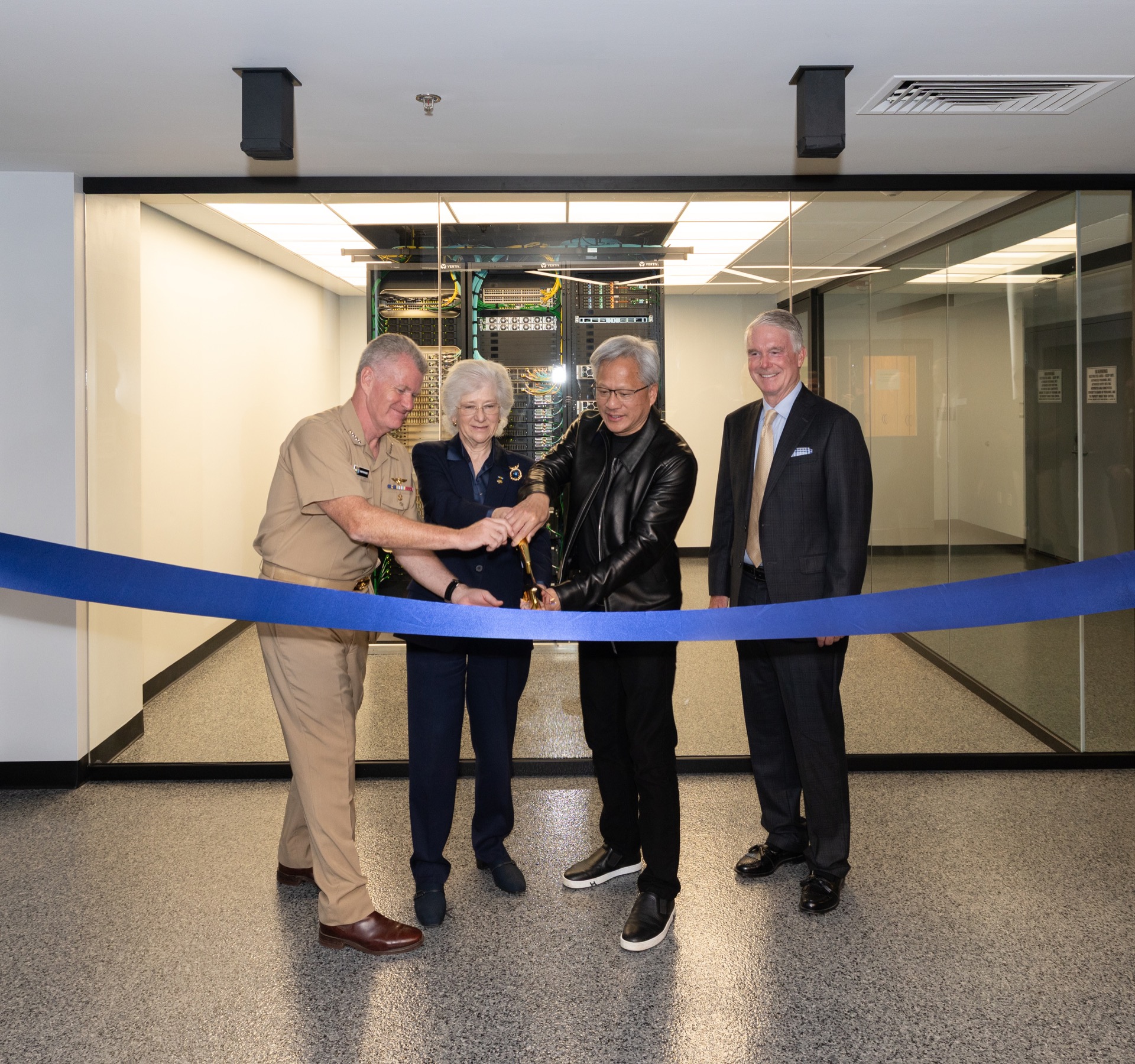
U.S. Navy Adm. Samuel J. Paparo, commander, U.S. Pacific Command; retired Vice Adm. Ann E. Rondeau, president of the NPS; Jensen Huang, founder and CEO of NVIDIA; and Hank Plain, board chair of the NPS Foundation unveiled the DGX GB300.
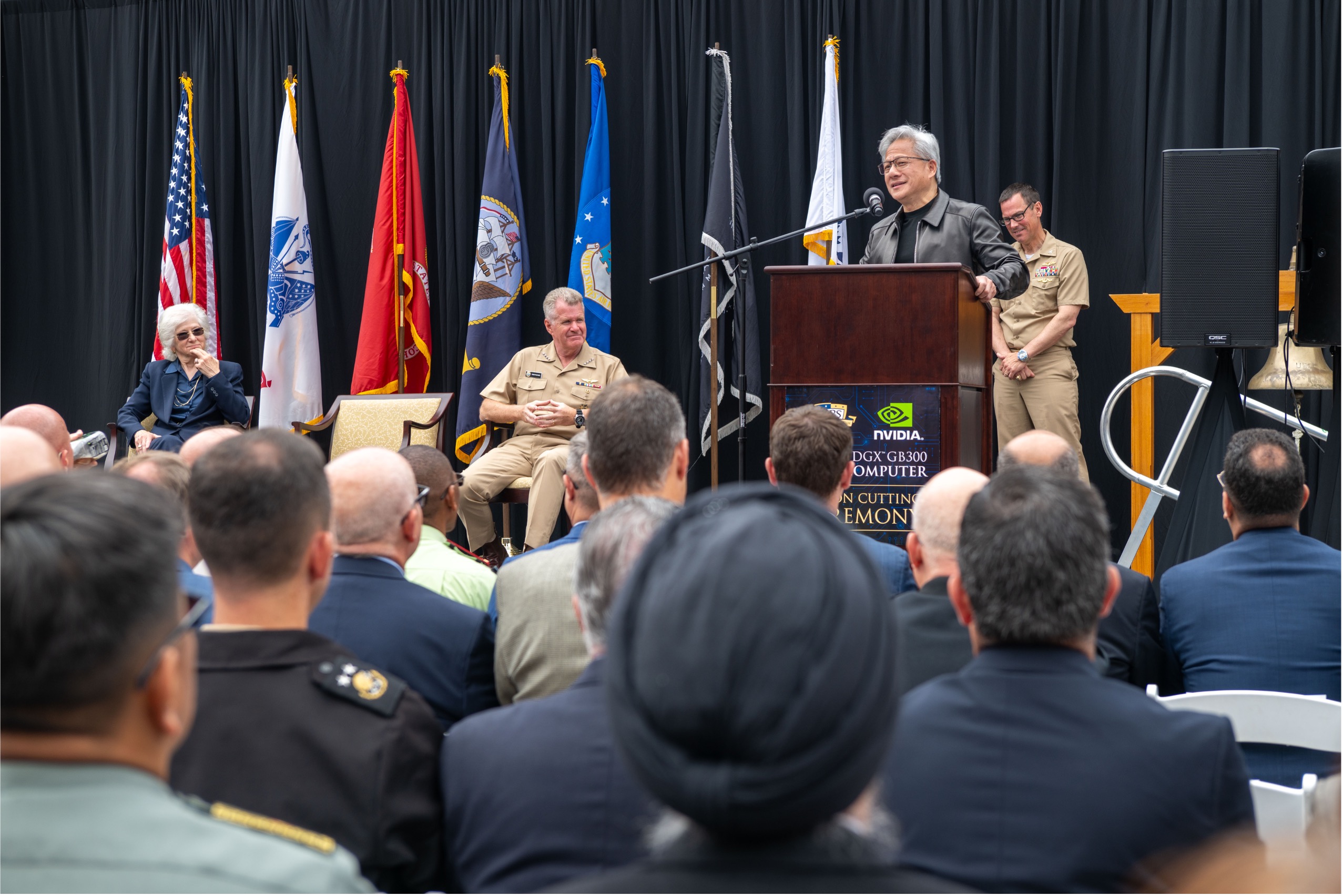
Jensen Huang, founder and CEO of NVIDIA, delivers remarks during the NVIDIA DGX GB300 AI supercomputer commissioning ceremony at the Naval Postgraduate School (NPS) in Monterey, California, July 22, 2026.
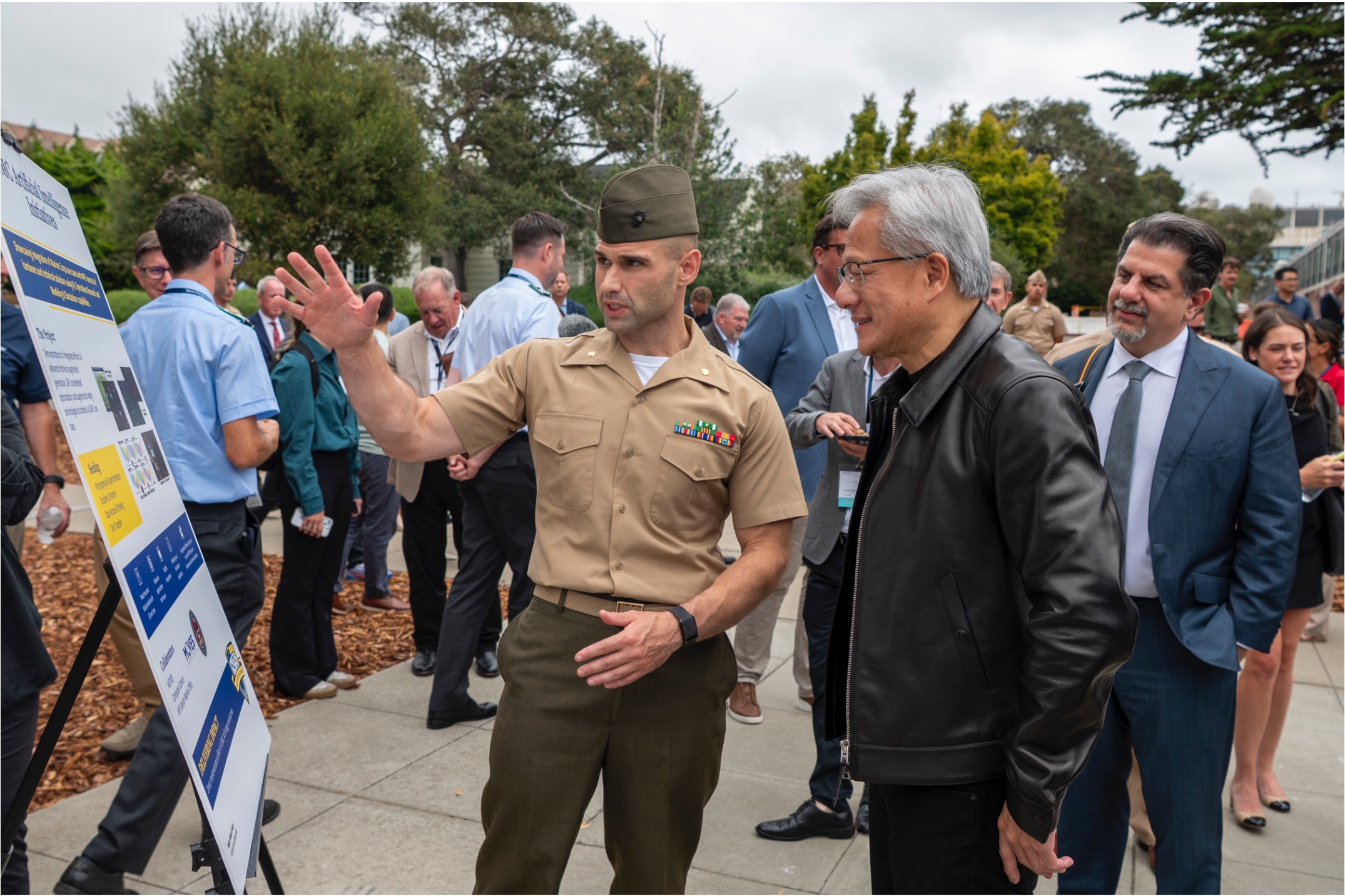
U.S. Marine Corps Maj. Robert Fusco, a Naval Postgraduate School (NPS) student, briefs Jensen Huang, founder and CEO of NVIDIA, during a research poster session at NPS in Monterey, California, July 22, 2026.
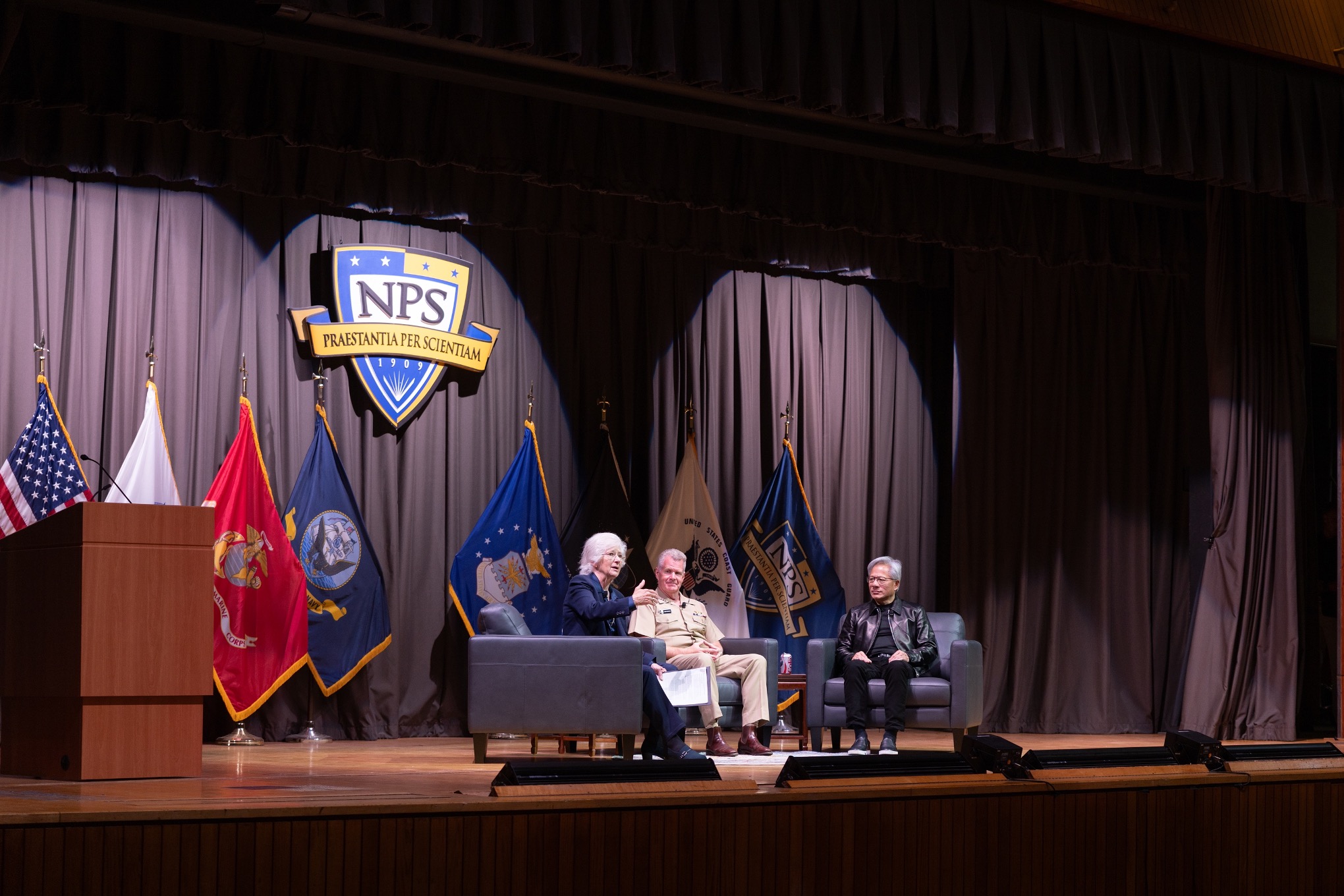
Retired U.S. Navy Vice Adm. Ann E. Rondeau, president of the Naval Postgraduate School (NPS), moderates a fireside chat with U.S. Navy Adm. Samuel J. Paparo, commander, U.S. Pacific Command, and Jensen Huang, founder and CEO of NVIDIA, at NPS in Monterey,
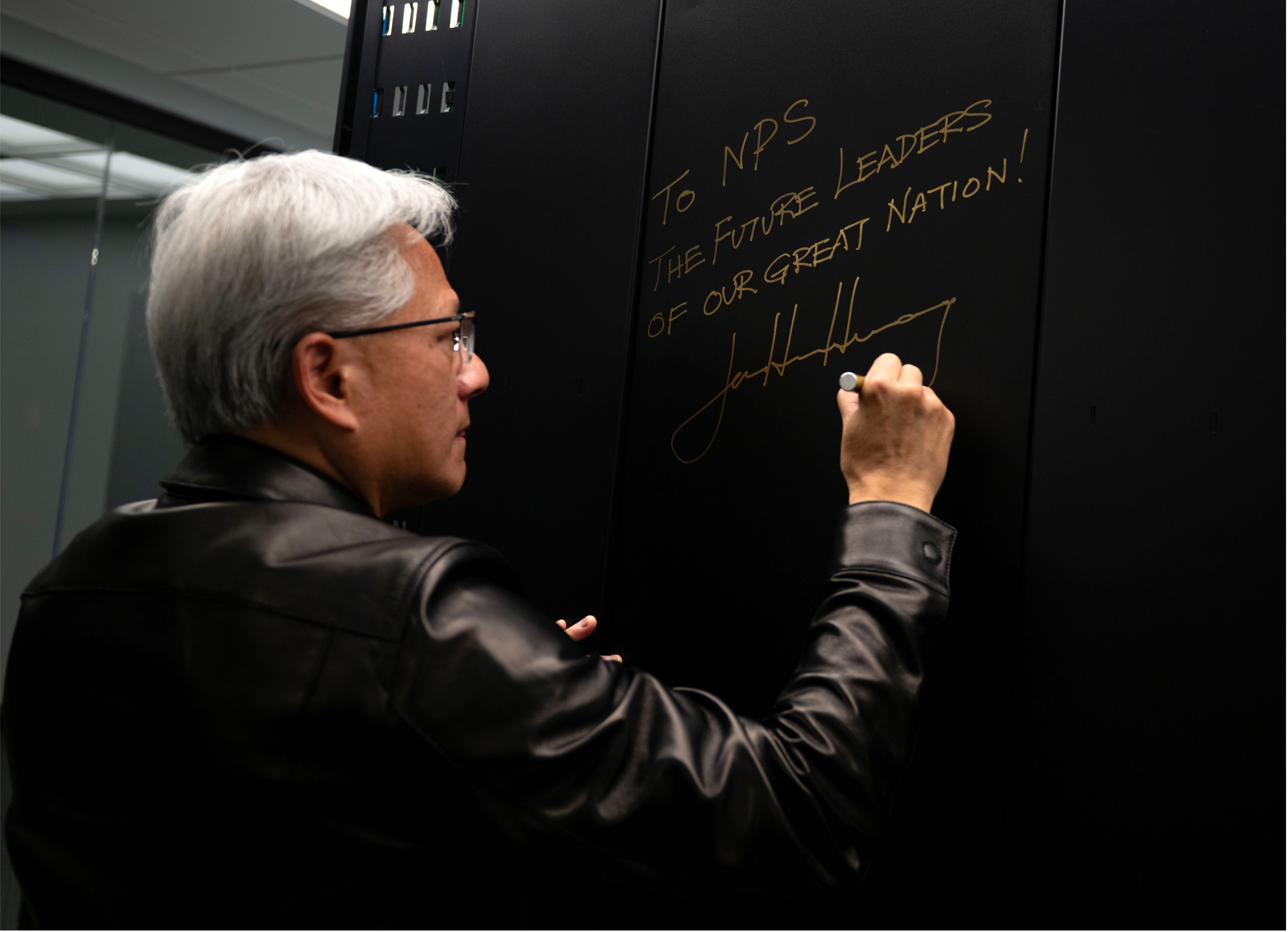
Jensen Huang, founder and CEO of NVIDIA, signs the exterior panel of the NVIDIA DGX GB300 AI supercomputer at the Naval Postgraduate School (NPS) in Monterey, California, July 22, 2026.
NVIDIA founder and CEO Jensen Huang with Commander U.S. Pacific Command Adm. Samuel J. Paparo joined leaders at NPS for commissioning of supercomputer
MONTEREY, CA, UNITED STATES, July 22, 2026 /EINPresswire.com/ -- For more than a century, the Naval Postgraduate School (NPS) has developed military leaders and research solutions to meet the unique needs of America’s Navy and national security.
Established in 1909 and now celebrating 75 years in Monterey, NPS has continually adapted to technological change while maintaining its focus on preparing leaders for national security. Today, that tradition continues at NPS with the arrival of the first NVIDIA DGX GB300 AI supercomputer in the U.S. military.
From aviation and radar to space, cyber, autonomy and artificial intelligence (AI), each era has introduced technologies that transformed how naval and joint forces operate and how the nation competes strategically. Each era has also demanded NPS graduates that are capable of understanding those technologies and applying them to increasingly complex operational challenges.
The DGX GB300 system supports ongoing collaborative AI research established under a Cooperative Research and Development Agreement (CRADA) between NPS and NVIDIA announced in December 2024, and was formally launched during a ribbon-cutting ceremony July 22, 2026 at NPS attended by NVIDIA founder and CEO Jensen Huang, Commander, U.S. Pacific Command Adm. Samuel J. Paparo, NPS President retired Vice Adm. Ann Rondeau along with faculty, students, military leaders and collaborators.
“AI will be a backbone of America’s defense,” said Huang. “By supporting the Naval Postgraduate School and placing one of the world’s most advanced AI supercomputers in the hands of the men and women who defend our Nation, we are empowering them to train on it, build with it, and lead America’s fighting force with the decisive advantages our Sailors, Marines and Joint Force deserve.”
The DGX GB300 dramatically expands NPS’ computational capabilities and will empower future leaders with AI skills for a number of critical use cases in operational challenges including weather modeling, oceanic and operations research, cybersecurity, disaster resilience, and response planning.
NVIDIA donated the DGX GB300 to the NPS Foundation, which installed it at NPS along with funding for research projects that require its high compute and memory capacity. Teams from Vertiv, DDN, VAST Data made contributions of infrastructure, storage and technical expertise which helped accelerate deployment of the capability.
The relationships enabled NPS to rapidly field an advanced computing capability through private-sector collaboration, demonstrating an effective approach for delivering technology, expertise and innovation in support of national security.
EDUCATION AS THE FOUNDATION OF TECHNOLOGICAL LEADERSHIP
Modern military leaders face operational environments characterized by unprecedented complexity and new challenges.
“The changing character of warfare impacts the entire spectrum of conflict,” said Paparo. “To achieve absolute decision superiority, we must leverage data, compute, and human-machine integration to observe, orient, decide, act, assess, learn and adjust faster than any adversary. As we connect these capabilities across space, sensors and networks, our operational advantage does not merely grow by addition, it compounds to deliver overwhelming joint effects.”
For NPS, that challenge lies at the heart of its strategic imperative — an education that drives cognitive readiness.
"Enduring advantage has never depended on technology alone, it depends on leaders with the intellect, wisdom and judgment first to deter conflict and, when necessary, fight decisively," Rondeau said. "Our mission at NPS is to prepare those leaders. By partnering with NVIDIA, we are bringing together world-leading AI capabilities, the expertise of our faculty and the ingenuity of our students to advance their education, accelerate research and develop solutions to some of the most pressing defense challenges."
Unlike traditional universities, NPS is a naval command with a graduate education mission focused exclusively on national defense. Its students are mid-career military officers and defense professionals who arrive with operational and combat experience and return directly to positions of increased leadership throughout the Navy and Marine Corps, the joint force, interagency organizations, and allied militaries.
“Education remains our greatest strategic advantage because, when all things are equal, the human element is the decisive difference,” continued Rondeau.
A LEGACY OF COMPUTING IN SERVICE TO THE U.S. MILITARY
Long before machine learning and AI emerged as a strategic priority, NPS was pioneering military applications of advanced computational science.
In 1953, NPS acquired its first electronic digital computer, and in 1960, received Seymour Cray’s world-first all solid-state supercomputer, Control Data Corp.’s CDC 1604 — serial number 1. At the time, the system placed NPS at the forefront of advanced computing and supported applications ranging from numerical weather prediction and ocean forecasting to operational fleet analysis.
Over the decades that followed, NPS contributed to advances in computer science, networking, modeling and simulation, operational analysis, cyber research, and computational applications while educating generations of military leaders.
Dr. Peter Denning, distinguished professor emeritus at NPS and an influential figure in the evolution of computer science and the Internet, said the institution has consistently recognized the strategic importance of computational capability.
“NPS has a long tradition of pioneering advances in computing that have served our Navy and the nation well,” said Denning. “Prior to the arrival of Seymour Cray’s first transistor-based electronic supercomputer, NPS hosted a copy of Vannevar Bush's Differential Analyzer, perhaps the most powerful analog computer of its day.
“Research in computer science at NPS included then professor Gary Kildall's creation of the world's first microcomputer disk operating system,” he continued, “early leadership in cybersecurity, and secure networking as one of the first ARPANET nodes, which became the technical foundation of the Internet.”
Looking ahead, Denning added, “NPS has consistently been at the forefront of computing innovation. NVIDIA's collaboration continues that tradition, creating new opportunities for breakthroughs in artificial intelligence and machine learning.”
PREPARING LEADERS FOR AN AI-ENABLED FUTURE
The decision to place the first DGX GB300 in the U.S. military at NPS was driven by a shared focus on education, research, innovation, and NPS’ unique role in preparing leaders for future national security roles.
“As we modernize our technology, we must also modernize how we educate our leaders. The officers studying at NPS today will return to the fleet and joint force ready to lead AI-enabled formations,” Paparo said, an NPS alumnus. “Access to advanced computing capability means NPS students and faculty understand the opportunities and responsibilities that come with these technologies.”
Leaders throughout the day emphasized that advances in computing and AI increase — not decrease — the importance of human judgment.
U.S. Navy Capt. Michael Owen, NPS vice provost for warfare studies and leader of the institution’s AI Task Force, said future military leaders must understand both the capabilities and limitations of advanced technologies.
“As advanced computational capabilities continue to evolve globally, responsible understanding and stewardship become even more important,” Owen said. “The question is not whether these technologies will exist. The question is whether future military leaders understand them well enough to evaluate their limitations, apply them ethically, and employ them responsibly in support of national security objectives.”
Owen said NPS must prepare leaders to evaluate emerging technologies, understand their operational implications, and integrate them responsibly into military decision-making.
FROM COMPUTING POWER TO OPERATIONAL ADVANTAGE
The NVIDIA DGX GB300 represents a significant step forward in computing capability at NPS. Installed within the school’s existing high-performance computing environment, the new computer is not a data center, but a fully integrated system that combines computing power, storage, networking, and software designed into a single, scalable platform.
This extreme co-design enables NPS to gain a substantial increase in computational capacity to the NPS.edu network while operating within the existing power and water infrastructure of the school.
At its core, the DGX GB300 pairs 36 NVIDIA Grace CPUs with 72 NVIDIA Blackwell Ultra GPUs, allowing it to process large volumes of work in parallel rather than just sequentially. This architecture is particularly well suited for large AI applications, where speed and scale are essential. It enables students and faculty to train models, analyze data, and explore complex problems that were previously out of reach.
“Initially, we will need to carefully manage demand as we bring this capability online,” said Trenton Hancock, NPS Chief Information Officer. “But what this system really gives us is the ability to explore more complex, real-world problems, especially those that mirror the challenges our operational fleet faces every day.”
While utilization is expected to grow steadily over time, the true value of this capability is not measured in compute hours alone. It is measured by how quickly NPS students and researchers can transform data into actionable knowledge, accelerate discovery, and develop solutions to pressing operational challenges.
“As this capability matures, it will allow student and faculty researchers at NPS to identify patterns faster, evaluate alternatives more rapidly, and generate deeper insights,” Hancock added. “The real value is accelerating the transformation of data into operationally relevant effects, reducing the time required to learn, adapt and make better decisions in support of naval forces.”
For the Navy, that requirement lies at the heart of U.S. seapower — decision advantage drives operational advantage.
LEARNING, LEADERSHIP, AND NATIONAL SECURITY
Following the ribbon-cutting ceremony, Huang and Paparo joined Rondeau for a campus-wide fireside discussion focused on technology, education and innovation. Questions gathered in advance challenged the leaders on topics including the impact of agentic AI, leading in an AI era, and AI as a strategic capability in a new industrial revolution.
Huang emphasized that future advantage will depend not only on AI technology itself, but on how quickly organizations learn, adopt, and adapt with AI. He encouraged everyone to engage with the technology, noting that today's AI makes it more accessible than ever and that success requires organizations to evolve their technology, information systems, and ways of working together.
The leaders went on to talk about AI as a new industrial revolution, as fundamental as electrification, railroads, semiconductors, and the Internet, and it will reshape productivity, scientific discovery, and national competitiveness.
Speaking directly to the students assembled, Paparo emphasized that technological superiority alone does not guarantee operational success.
“Many of you will command in AI-enabled environments. Information will move at lightning speeds, compressing response times,” Paparo said. “Our advantage will come from leaders, like you, who can use the technology to see, understand, decide and act faster while exercising the judgment, experience and leadership that machines cannot provide. That education is happening here at NPS.”
As an NPS alumnus himself, Paparo highlighted the enduring value of advanced education in preparing military leaders for future challenges and stressed the importance of institutions that connect emerging technologies with operational realities.
His remarks echoed a theme repeated throughout the day — technology alone does not create advantage, leaders educated to understand and employ it do.
At NPS, those leaders are already in the classroom.
LOOKING AHEAD
Leaders throughout the day described the DGX GB300 as one example of a strategic collaboration connecting NPS, industry and military stakeholders focused on preparing future leaders and exploring applications of emerging technologies critical to national security needs.
With the commissioning complete, attention now turns from installation to application. The NVIDIA DGX GB300 at NPS will support education, research, experimentation, and mission-focused problem solving across a growing range of national security challenges.
Rondeau shared her thoughts on the significance of the event and what it means for NPS.
“Education has always been the great equalizer,” said Rondeau. “Our national security ultimately rests in the quality of its people, and our mission is to educate those people for our Navy and military. NPS students carry their education and research forward into the fleet, the joint force, and positions of national responsibility, and that is why we invest in giving them the tools needed to think critically, adapt confidently, and make sound decisions in service to the nation.”
-----------------
Mission of the Naval Postgraduate School: To provide defense-focused graduate education, including classified studies and interdisciplinary research, to advance the operational effectiveness, technological leadership and warfighting advantage of the Naval service.
Public Affairs Office
Naval Postgraduate School
831-656-3567
email us here
Visit us on social media:
LinkedIn
Instagram
Facebook
YouTube
X
Legal Disclaimer:
EIN Presswire provides this news content "as is" without warranty of any kind. We do not accept any responsibility or liability for the accuracy, content, images, videos, licenses, completeness, legality, or reliability of the information contained in this article. If you have any complaints or copyright issues related to this article, kindly contact the author above.
