

Silicon Photonics Market Set for Rapid Expansion, Forecast to Hit USD 27.35 Billion by 2035
Silicon Photonics Market
Silicon Photonics Market Size, Share and Research Report By Product (Optical Transceivers, Optical Switches, Silicon Photonic Sensors, Others), By Component
Silicon Photonics Market: Accelerating as high-speed data transmission needs drive integration of optical and electronic components in advanced computing systems.”
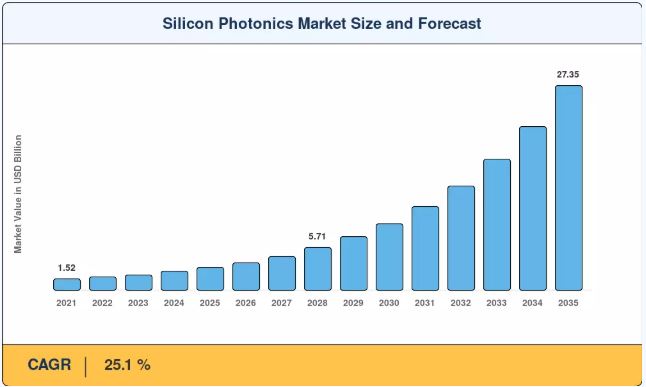
YOKOHAMA, KANAGAWA PREFECTURE, JAPAN, June 26, 2026 /EINPresswire.com/ -- The Global silicon photonics market reached an estimated USD 3.04 Billion in 2025 and is projected to grow from to USD 27.35 Billion by 2035, registering a CAGR of 25.1% during the forecast period. — Market Research Future (MRFR)
Two major catalysts are propelling this explosive trajectory: the insatiable bandwidth demand from hyperscale data centers where global AI training and inference workloads are projected to drive optical interconnect traffic up by more than 300% between 2024 and 2030 and the rapid maturation of co-packaged optics (CPO) architectures that are replacing traditional pluggable transceivers at the chip-to-chip interconnect level. With global data center operators racing to overcome the electrical interconnect bandwidth wall, silicon photonics has moved from a niche optical communications technology to a foundational pillar of next-generation AI compute infrastructure.
Legacy discrete optical components and copper-based electrical interconnects are giving way to monolithically integrated silicon photonic circuits that combine lasers, modulators, waveguides, and detectors on CMOS-compatible substrates.
A recent LightCounting industry analysis estimated that silicon photonics-based transceivers operating at 800G and 1.6T data rates are being deployed at scale by hyperscalers including Microsoft, Google, Meta, and Amazon, with the technology now extending beyond data center interconnects into emerging applications such as LiDAR for autonomous vehicles, biosensing, and quantum computing interconnects. This shift is not incremental it reflects a structural re-architecture of how optical and electronic functions converge on a single chip.
Get Full PDF Sample Copy of Report: (Including Full TOC, List of Tables & Figures, Chart) @
https://www.marketresearchfuture.com/sample_request/2809
➤How Significant Is the Silicon Photonics Market’s Growth?
The silicon photonics market has demonstrated extraordinary and accelerating expansion, rising from approximately USD 1,156.8 million in 2021 to an estimated USD 3.04 Billion in 2025, nearly doubling within four years on the back of surging cloud infrastructure investment. The market is projected to grow nearly eightfold over the next decade, propelled by the generative AI infrastructure buildout, the transition from 400G to 800G and 1.6T optical interconnects in hyperscale data centers, and the emergence of co-packaged optics as the dominant architecture for next-generation AI accelerator clusters.
Surging demand for high-bandwidth, low-latency, energy-efficient interconnects within AI training clusters has created acute pressure on traditional pluggable optics, which are approaching fundamental power and density limits as data rates climb beyond 800G per lane. Hyperscale cloud providers, network equipment vendors, and semiconductor foundries are all investing heavily in silicon photonics integration to reduce per-bit power consumption, increase interconnect density, and shorten the electrical reach between compute and optical I/O a critical requirement as GPU and AI accelerator clusters scale into the hundreds of thousands of nodes.
➤What Does the Future Hold for the Silicon Photonics Market?
Co-packaged optics (CPO) stands at the forefront of the market’s next growth phase. By integrating optical engines directly alongside switch ASICs and AI accelerators on the same substrate or interposer, CPO architectures eliminate the power-hungry electrical SerDes links required by traditional pluggable transceivers delivering power efficiency improvements of 30–50% at equivalent bandwidth. Major switch silicon vendors and hyperscalers have already announced CPO-based switch platforms targeting deployment in next-generation AI data center fabrics, with broader commercial rollout expected to accelerate significantly between 2026 and 2030.
Heterogeneous integration of III-V laser sources onto silicon substrates is another defining force shaping the market’s future. Since silicon is an indirect-bandgap material and cannot natively generate laser light efficiently, techniques such as wafer bonding, micro-transfer printing, and quantum dot laser growth on silicon are being industrialized to enable fully integrated light sources on photonic chips reducing assembly complexity and cost while improving yield and reliability at high-volume manufacturing scale.
Beyond data center interconnects, silicon photonics is poised to expand into automotive LiDAR, where photonic integrated circuits enable solid-state, low-cost beam-steering systems for advanced driver-assistance systems (ADAS) and autonomous vehicles. Emerging applications in biosensing including lab-on-chip diagnostics and continuous health monitoring and quantum photonic computing, where silicon photonic chips serve as the interconnect fabric for scalable quantum processors, represent significant long-term growth vectors that are attracting substantial venture capital and government research funding.
➤Who Are the Key Players in the Silicon Photonics Market?
The silicon photonics landscape is characterized by a dynamic mix of integrated device manufacturers, foundry ecosystem partners, optical component specialists, and emerging photonic chip startups. Key participants shaping the competitive dynamics include:
✿Intel Corporation — a pioneer in silicon photonics with high-volume manufacturing of integrated optical transceivers and ongoing development of co-packaged optics for data center and AI interconnect applications
✿Cisco Systems (Acacia Communications) — providing high-speed coherent and silicon photonics-based optical interconnect solutions for telecom and data center networks
✿Broadcom Inc. — delivering silicon photonics-based optical engines and co-packaged optics platforms integrated with its switch silicon for hyperscale data center deployments
✿GlobalFoundries — operating a leading silicon photonics foundry platform (Fotonix) supporting a broad ecosystem of fabless photonic chip designers
✿Marvell Technology — providing silicon photonics-based 800G and 1.6T optical DSPs and interconnect solutions for AI and cloud data center customers
✿Lumentum Holdings — offering silicon photonics and indium phosphide-based optical components for telecom, datacom, and emerging 3D sensing applications
✿II-VI Incorporated (Coherent Corp.) — providing a broad photonics component portfolio spanning lasers, modulators, and integrated photonic engines for data communications and industrial markets
✿STMicroelectronics — operating a dedicated silicon photonics manufacturing platform supporting both internal and foundry customer photonic IC production
✿Ayar Labs — a leading startup developing optical I/O chiplets that enable direct optical interconnects between AI accelerators, GPUs, and switches
✿Lightmatter — pioneering photonic computing and optical interconnect chiplets purpose-built for next-generation AI infrastructure
Competition in the market is intensifying as vendors race to scale co-packaged optics manufacturing yield, secure foundry capacity for photonic-electronic integration, and forge strategic partnerships with hyperscale cloud providers seeking custom optical interconnect solutions for proprietary AI accelerator architectures. Strategic investments and acquisitions targeting heterogeneous laser integration and advanced packaging capabilities are reshaping competitive positioning across the value chain.
➤What Are the Emerging Trends in the Silicon Photonics Market?
Several transformational trends are redefining how the silicon photonics market evolves through 2035:
Co-Packaged Optics (CPO) Commercialization: The shift from pluggable transceivers to optics integrated directly with switch and accelerator silicon is accelerating, driven by the urgent need to reduce interconnect power consumption in AI training clusters.
AI/ML-Driven Optical Interconnect Demand: The scale-up and scale-out networking requirements of large language model training clusters are driving unprecedented demand for high-bandwidth, low-latency optical interconnects between GPUs, accelerators, and switches.
Heterogeneous Laser Integration: Advances in wafer bonding, micro-transfer printing, and quantum dot laser-on-silicon techniques are enabling fully integrated light sources, reducing packaging complexity and improving manufacturing yield at scale.
Optical I/O Chiplets for AI Accelerators: Emerging optical chiplet architectures are enabling direct photonic interconnects between compute dies, bypassing traditional electrical SerDes bottlenecks and unlocking new levels of system-level bandwidth density.
Automotive LiDAR Integration: Silicon photonic beam-steering and FMCW LiDAR chips are gaining traction as automakers seek solid-state, cost-effective sensing solutions for ADAS and autonomous driving platforms.
Quantum Photonic Computing Interconnects: Silicon photonics is emerging as a critical enabling technology for scalable quantum computing architectures, providing low-loss optical interconnect fabric between qubit modules and control electronics.
Get access to the full description of the report @
https://www.marketresearchfuture.com/reports/silicon-photonics-market-2809
➤How Is the Silicon Photonics Market Segmented?
The silicon photonics market report provides a comprehensive segmentation framework:
By Component: Transceivers, Variable Optical Attenuators, Switches, WSS (Wavelength Selective Switches), Cables, Sensors
By Product: Optical Transceivers, Optical Switches, Optical Cables, Photonic Sensors, Co-Packaged Optics
By Application: Data Center & High-Performance Computing, Telecommunications, Military & Defense, Medical & Life Sciences, Automotive (LiDAR), Consumer Electronics
By Data Rate: 100G/200G, 400G, 800G, 1.6T & Above
By Organization Size: SMEs, Large Enterprises (Hyperscalers & Network Operators)
➤What Are the Regional Insights from the Silicon Photonics Market?
North America commands approximately 39% of global silicon photonics market share, underpinned by the world’s largest concentration of hyperscale data center operators, leading-edge semiconductor foundry and packaging infrastructure, and aggressive AI infrastructure capital expenditure from companies including Microsoft, Google, Amazon, and Meta. The United States CHIPS and Science Act is further catalyzing domestic silicon photonics manufacturing and advanced packaging capacity, reinforcing the region’s position at the forefront of optical interconnect innovation.
Asia-Pacific represents the fastest-growing region and is expected to command an increasingly significant share through 2035, driven by Taiwan’s dominant position in advanced semiconductor foundry and packaging services, China’s aggressive domestic silicon photonics R&D investment amid technology self-sufficiency initiatives, and expanding data center and 5G/6G network infrastructure buildouts across Japan, South Korea, and Singapore. TSMC’s expanding silicon photonics and advanced packaging capabilities are positioning the region as a critical manufacturing hub for global optical interconnect supply chains.
Europe holds a meaningful share of the global market, with the United Kingdom, Germany, France, and the Netherlands representing key centers of photonic research and manufacturing activity. The European Union’s Photonics21 strategic research initiative and Horizon Europe funding programs are supporting fundamental silicon photonics R&D, while companies in the region maintain strong positions in telecom optical components and specialized sensing applications.
The Middle East is emerging as a notable growth region, driven by large-scale sovereign AI infrastructure investments in the UAE and Saudi Arabia, where hyperscale data center buildouts supporting national AI strategies are creating incremental demand for advanced optical interconnect technologies sourced from global silicon photonics suppliers.
Latin America rounds out the global picture with a smaller but growing presence, as Brazil and Mexico expand data center and telecommunications infrastructure to support rising cloud service and digital economy demand. While the region currently represents a modest share of global silicon photonics consumption, increasing regional cloud investment is expected to drive incremental growth in optical interconnect demand through the forecast period.
➤➤➤ Market Research Future's Regional Market Analysis:
Us Silicon Photonics Market-
https://www.marketresearchfuture.com/reports/us-silicon-photonics-market-13214
➤➤➤ Industry Analysis Reports by Market Research Future:
Touch Sensors Market -
https://www.marketresearchfuture.com/reports/touch-sensor-market-897
Substation Automation Market-
https://www.marketresearchfuture.com/reports/substation-automation-market-1016
Field Programmable Gate Array Market-
https://www.marketresearchfuture.com/reports/field-programmable-gate-array-market-1019
Automated Material Handling Market-
https://www.marketresearchfuture.com/reports/automated-material-handling-market-1029
3D Nand Memory Market-
https://www.marketresearchfuture.com/reports/3d-nand-memory-market-1040
Embedded Technology Market-
https://www.marketresearchfuture.com/reports/embedded-technology-market-1041
Capacitive Sensor Market-
https://www.marketresearchfuture.com/reports/capacitive-sensor-market-1077
Access Control Market-
https://www.marketresearchfuture.com/reports/access-control-market-1089
Digital Signage Market-
https://www.marketresearchfuture.com/reports/digital-signage-market-1102
Intelligent Virtual Assistant Market-
https://www.marketresearchfuture.com/reports/intelligent-virtual-assistant-market-1147
Sagar Kadam
Market Research Future
+1 628-258-0071
email us here
Legal Disclaimer:
EIN Presswire provides this news content "as is" without warranty of any kind. We do not accept any responsibility or liability for the accuracy, content, images, videos, licenses, completeness, legality, or reliability of the information contained in this article. If you have any complaints or copyright issues related to this article, kindly contact the author above.
