

Responsible AI at Scale: Lessons from Stuart Feld on the Chief AI Officer Podcast with Sanjay Puri

CAIO Connect Podcast
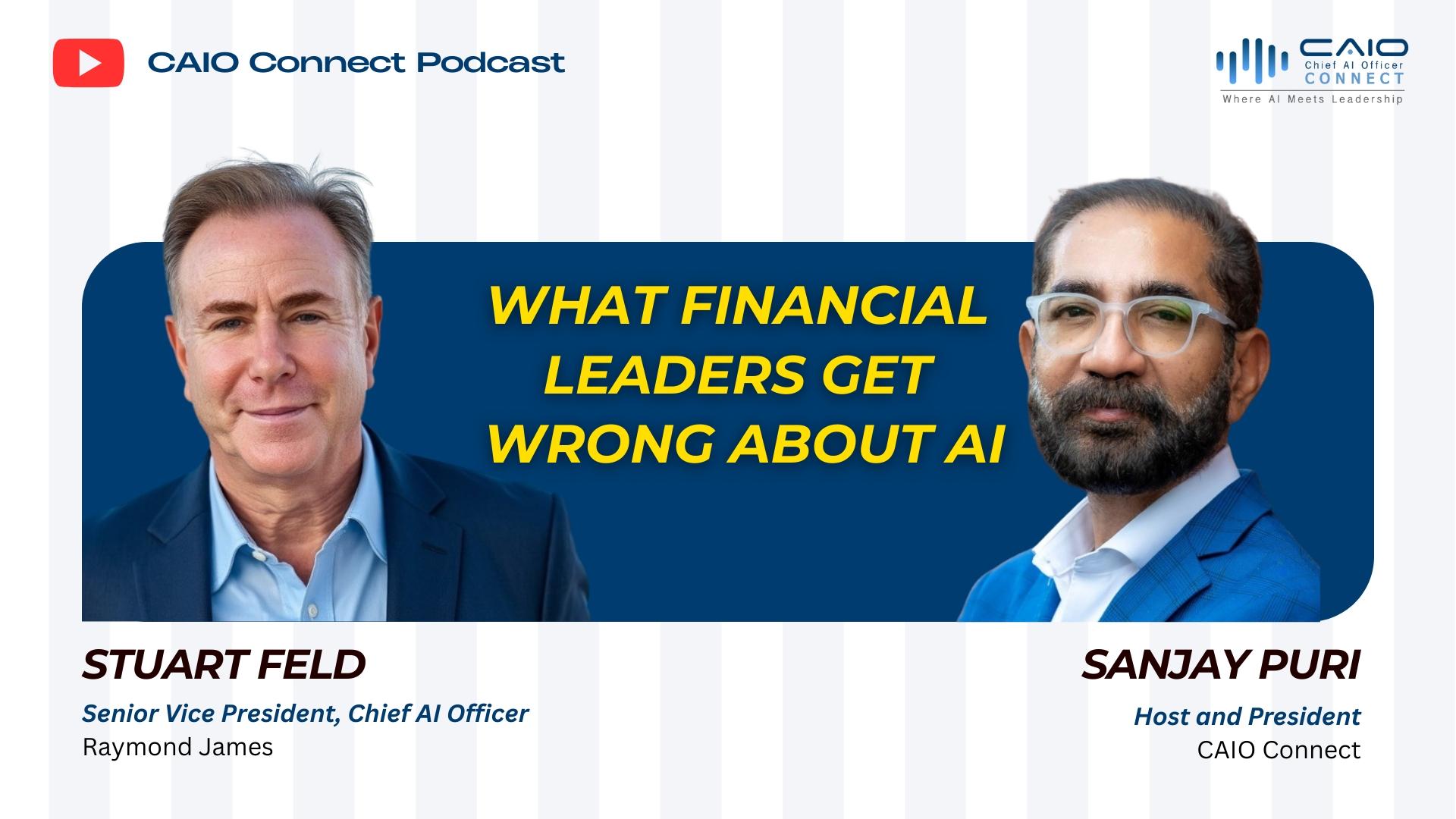
Stuart Feld, Senior Vice President at Raymond James with Sanjay Puri, President of Knowledge Networks
On the CAIO Podcast with Sanjay Puri, Stuart Feld shares how Raymond James scales AI responsibly—prioritizing human judgment, real ROI, and execution over hype.
What made this conversation stand out was not futuristic speculation, but practical insight from someone actively leading AI transformation inside a large enterprise.
Why AI Is Different This Time
Feld makes a compelling observation: AI is the first truly transformative technology that was adopted by the general public before the enterprise. Unlike cloud, mobile, or algorithmic trading, AI tools like ChatGPT became mainstream almost overnight—forcing enterprises to react rather than lead. With billions of users engaging with AI daily, organizations can no longer afford to treat it as experimental.
This reality shaped Raymond James’ approach and ultimately led to the creation of a dedicated Chief AI Officer role in early 2025.
From Machine Learning to Enterprise AI Leadership
AI wasn’t new to Raymond James. Feld and his teams had been delivering machine learning solutions for years, particularly in back-office compliance and supervision—areas where AI delivered measurable dividends. The difference was credibility: Feld wasn’t advocating AI in theory; he was solving real business problems with it.
That track record made the CAIO role a natural evolution rather than a leap of faith. The mandate wasn’t hype—it was scale, governance, and accountability.
AI That Evolves, Not Expires
One of the most relatable moments in the conversation was Feld’s reframing of a common fear: “Whatever we build today will be obsolete in 12 months.”
His response? Obsolete doesn’t mean useless.
AI systems, when designed well, get better over time. Core machine learning foundations and GenAI capabilities evolve rather than being thrown away. While experimental layers like agent-to-agent communication or model context protocols may change rapidly, the underlying architecture compounds in value.
The lesson for leaders: design for iteration, not permanence.
Human-in-the-Loop Isn’t a Constraint—It’s a Strategy
At Raymond James, AI is not used to replace judgment. It’s used to accelerate it.
Feld is clear: AI should do what humans already do—but faster. Tasks that take an advisor an hour can be done in seconds, freeing time for higher-value work. AI surfaces information, highlights opportunities, and reduces low-joy administrative effort—but the final decision always rests with a human.
This “human-in-the-loop” approach is non-negotiable, especially in financial services where explainability, traceability, and accountability matter as much as accuracy.
A Practical AI Maturity Model
Feld outlines a simple but powerful trajectory for enterprise AI adoption:
Surface general information
Surface personalized insights
Recommend actions
Eventually execute actions—with human approval
Most organizations, including Raymond James, are firmly in the first two stages today. Action comes later, once trust, governance, and explainability are firmly in place.
Agentic AI: Experiment First, Deploy Carefully
Despite the buzz, Feld notes that very few organizations are running truly autonomous AI agents in production. Most are experimenting—testing security, scalability, and integration with existing APIs.
For mission-critical functions, Feld doesn’t yet see autonomous agents operating without human oversight. And that caution isn’t just regulatory—it’s philosophical.
The Big Takeaway for AI Leaders
AI remains deeply underrated. There is enormous low-hanging fruit that can deliver immediate value without moonshots. Feld’s advice is simple and powerful: focus less on proofs of concept and more on real implementation.
Boards don’t want to hear what AI might do someday. They want to know what it’s doing now.
And as this CAIO Connect Podcast episode makes clear, responsible, human-centered AI isn’t slower—it’s the fastest path to sustainable scale.
Upasana Das
Knowledge Networks
email us here
Visit us on social media:
LinkedIn
Instagram
Facebook
YouTube
X
Legal Disclaimer:
EIN Presswire provides this news content "as is" without warranty of any kind. We do not accept any responsibility or liability for the accuracy, content, images, videos, licenses, completeness, legality, or reliability of the information contained in this article. If you have any complaints or copyright issues related to this article, kindly contact the author above.
