

Global MRD Testing Market Expands Rapidly as Precision Oncology Drives Early Cancer Detection
Minimal Residual Disease Testing
Rising cancer prevalence and advanced NGS-based diagnostics push the MRD testing market toward US$ 4.8 billion by 2031.
MRD testing is redefining cancer care by detecting what traditional tools miss, enabling earlier intervention, personalized therapy, and better long-term patient outcomes.”
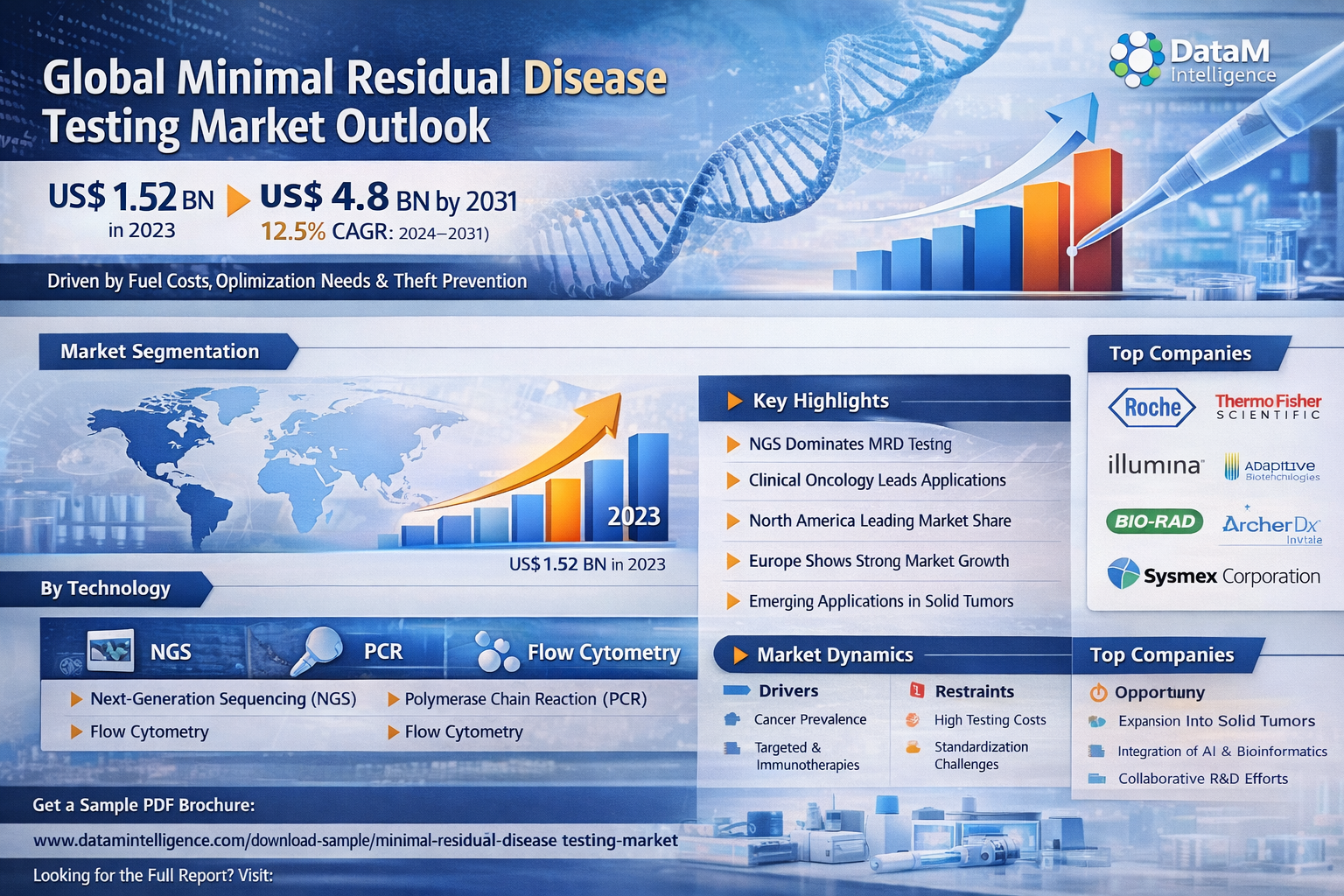
AUSTIN, TX, UNITED STATES, December 19, 2025 /EINPresswire.com/ -- According to DataM Intelligence, the global minimal residual disease testing market was valued at approximately US$ 1.52 billion in 2023 and is expected to reach around US$ 4.8 billion by 2031, growing at a robust CAGR of nearly 12.5% during the forecast period. This growth is driven by the rising prevalence of cancer, increasing adoption of targeted therapies, advancements in molecular diagnostic technologies, and growing awareness of the clinical utility of MRD testing in guiding treatment decisions. Among testing methods, next-generation sequencing-based MRD testing represents the leading segment due to its high sensitivity and ability to detect diverse genetic alterations. Geographically, North America dominates the market owing to advanced healthcare infrastructure, strong presence of leading diagnostic companies, and high adoption of precision oncology, while Europe follows closely with increasing integration of MRD testing into clinical guidelines.— DataM Intelligence
𝗚𝗲𝘁 𝗮 𝗦𝗮𝗺𝗽𝗹𝗲 𝗣𝗗𝗙 𝗕𝗿𝗼𝗰𝗵𝘂𝗿𝗲 𝗼𝗳 𝘁𝗵𝗲 𝗥𝗲𝗽𝗼𝗿𝘁 (𝗨𝘀𝗲 𝗖𝗼𝗿𝗽𝗼𝗿𝗮𝘁𝗲 𝗘𝗺𝗮𝗶𝗹 𝗜𝗗 𝗳𝗼𝗿 𝗮 𝗤𝘂𝗶𝗰𝗸 𝗥𝗲𝘀𝗽𝗼𝗻𝘀𝗲): https://www.datamintelligence.com/download-sample/minimal-residual-disease-testing-market
Minimal Residual Disease (MRD) testing has emerged as a transformative diagnostic and prognostic tool in modern oncology and hematology. MRD refers to the small number of cancer cells that remain in a patient’s body after treatment and are often undetectable using conventional diagnostic methods. These residual cells can eventually lead to disease relapse, making their early and accurate detection critical for effective disease management. MRD testing leverages highly sensitive technologies such as next-generation sequencing (NGS), polymerase chain reaction (PCR), and flow cytometry to detect cancer cells at extremely low levels, enabling clinicians to assess treatment response, predict relapse risk, and tailor personalized treatment strategies. As precision medicine continues to redefine cancer care, MRD testing is becoming a standard component of clinical decision-making, particularly in hematological malignancies such as leukemia, lymphoma, and multiple myeloma.
Recent Developments
- In November 2025, Adaptive Biotechnologies expanded its NGS-based MRD testing portfolio for multiple myeloma and leukemia, supported by increased investment in clinical collaborations.
- In October 2025, Roche Diagnostics launched an advanced digital PCR-based MRD assay designed to improve sensitivity and workflow efficiency in hospital laboratories.
Key Highlights from the Report
➤ MRD testing is increasingly used as a key prognostic tool in hematological malignancies.
➤ Next-generation sequencing (NGS) dominates the market due to superior sensitivity.
➤ Clinical oncology applications account for the largest share of MRD testing demand.
➤ North America leads the market with strong adoption of precision medicine.
➤ Europe shows steady growth supported by favorable regulatory frameworks.
➤ Expanding applications in solid tumors present significant future opportunities.
Market Segmentation
The minimal residual disease testing market is segmented based on technology, application, cancer type, end-user, and sample type, reflecting the diverse clinical and research use cases of MRD testing.
- By technology, the market includes next-generation sequencing (NGS), polymerase chain reaction (PCR), and flow cytometry. NGS-based MRD testing holds the largest market share due to its ultra-high sensitivity, scalability, and ability to detect multiple genetic mutations simultaneously. PCR-based methods, including digital PCR and quantitative PCR, are widely used due to their cost-effectiveness and established clinical utility. Flow cytometry remains an important technology, particularly in hospital laboratories, for rapid and cost-efficient MRD assessment in certain blood cancers.
- By application, MRD testing is primarily used for treatment response monitoring, disease prognosis, relapse risk assessment, and therapy optimization. Treatment response monitoring represents the dominant application, as MRD status is increasingly used to evaluate the effectiveness of chemotherapy, immunotherapy, and targeted treatments. Prognostic applications are also gaining prominence, with MRD negativity often associated with improved survival outcomes.
- By cancer type, the market covers acute lymphoblastic leukemia (ALL), acute myeloid leukemia (AML), chronic lymphocytic leukemia (CLL), multiple myeloma, lymphoma, and an emerging segment of solid tumors. Hematological malignancies account for the majority of MRD testing demand due to well-established clinical evidence supporting MRD-guided treatment decisions. However, ongoing research is expanding the application of MRD testing to solid tumors such as breast, colorectal, and lung cancer through liquid biopsy approaches.
- By sample type, MRD testing utilizes blood, bone marrow, and other biological samples. Blood-based MRD testing is gaining popularity due to its minimally invasive nature and compatibility with liquid biopsy technologies. Bone marrow samples remain a standard in certain leukemia and myeloma assessments, although efforts are underway to reduce reliance on invasive sampling.
- By end-user, the market serves hospitals, diagnostic laboratories, academic & research institutes, and pharmaceutical & biotechnology companies. Diagnostic laboratories dominate the market due to centralized testing capabilities and growing partnerships with hospitals and oncology centers. Pharmaceutical and biotech companies are increasingly adopting MRD testing in clinical trials to evaluate treatment efficacy and support regulatory submissions.
Looking For A Detailed Full Report? Get it here: https://www.datamintelligence.com/buy-now-page?report=minimal-residual-disease-testing-market
Regional Insights
- North America holds the largest share of the global minimal residual disease testing market, driven by advanced diagnostic infrastructure, high healthcare spending, and early adoption of precision oncology practices. The United States is the key contributor, supported by strong clinical research activity, favorable reimbursement policies for advanced diagnostics, and widespread integration of MRD testing into cancer treatment protocols.
- Europe represents the second-largest market, with countries such as Germany, the UK, France, and Italy leading adoption. The region benefits from well-established oncology research networks, increasing clinical guideline support for MRD testing, and growing investments in molecular diagnostics. European healthcare systems are progressively incorporating MRD status into treatment decision frameworks, particularly in hematological cancers.
- The Asia-Pacific region is expected to witness the fastest growth during the forecast period. Rising cancer incidence, expanding access to advanced diagnostic technologies, and increasing investments in healthcare infrastructure are key growth drivers. Countries such as China, Japan, South Korea, and India are strengthening their molecular diagnostics capabilities, while collaborations between global diagnostic companies and regional laboratories are accelerating market penetration.
- Latin America and the Middle East & Africa represent emerging markets with untapped potential. Although adoption levels are currently lower due to limited access and cost constraints, improving healthcare infrastructure, increasing cancer awareness, and growing participation in global clinical trials are expected to support gradual market expansion in these regions.
Market Dynamics
1) Market Drivers
The primary driver of the MRD testing market is the rising prevalence of cancer, particularly hematological malignancies, combined with the growing emphasis on precision medicine. Advances in targeted therapies and immunotherapies have increased the need for sensitive tools that can accurately measure treatment response. MRD testing provides clinicians with actionable insights that enable personalized treatment decisions, reduce overtreatment, and improve patient outcomes. Additionally, regulatory agencies and clinical guidelines increasingly recognize MRD as a surrogate endpoint in clinical trials, further driving adoption.
2) Market Restraints
Despite strong growth potential, the market faces challenges such as high testing costs, especially for NGS-based MRD assays, which can limit accessibility in resource-constrained settings. Technical complexity, lack of standardized protocols across laboratories, and variability in interpretation of MRD results also pose challenges. Furthermore, limited reimbursement coverage in certain regions may hinder widespread adoption.
3) Market Opportunities
The market offers significant opportunities through the expansion of MRD testing into solid tumors, supported by advances in liquid biopsy technologies. Integration of artificial intelligence and bioinformatics tools for data interpretation can further enhance test accuracy and clinical utility. Growing collaboration between diagnostic companies, pharmaceutical firms, and research institutions in drug development and companion diagnostics presents additional growth avenues. Emerging markets also offer long-term opportunities as access to advanced diagnostics improves.
Get Customization in the report as per your requirements: https://www.datamintelligence.com/customize/minimal-residual-disease-testing-market
Reasons to Buy the Report
✔ Gain comprehensive insights into the global MRD testing market landscape.
✔ Identify high-growth technologies and applications driving market expansion.
✔ Understand regional trends and investment opportunities across key markets.
✔ Analyze competitive strategies of leading diagnostic and biotechnology companies.
✔ Support strategic decision-making with reliable forecasts from DataM Intelligence.
Frequently Asked Questions (FAQs)
◆ How big is the global minimal residual disease testing market?
◆ Who are the key players in the global MRD testing market?
◆ What is the projected growth rate of the minimal residual disease testing market?
◆ What is the market forecast for MRD testing through 2031?
◆ Which region is estimated to dominate the MRD testing industry during the forecast period?
Company Insights
Key players operating in the minimal residual disease testing market include:
• Roche Diagnostics
• Thermo Fisher Scientific Inc.
• Illumina Inc.
• Adaptive Biotechnologies
• F. Hoffmann-La Roche Ltd.
• Bio-Rad Laboratories
• ArcherDx (Invitae)
• Sysmex Corporation
Conclusion
The minimal residual disease testing market is poised for substantial growth as oncology care increasingly shifts toward precision and personalization. Insights from DataM Intelligence highlight the critical role of MRD testing in improving treatment outcomes, guiding therapeutic decisions, and accelerating drug development. While challenges related to cost and standardization remain, ongoing technological advancements and expanding clinical applications are expected to drive widespread adoption. As healthcare systems worldwide prioritize early detection and personalized care, MRD testing will continue to play a pivotal role in shaping the future of cancer diagnostics and treatment.
Sai Kiran
DataM Intelligence 4market Research LLP
+1 877-441-4866
sai.k@datamintelligence.com
Visit us on social media:
LinkedIn
YouTube
X
Legal Disclaimer:
EIN Presswire provides this news content "as is" without warranty of any kind. We do not accept any responsibility or liability for the accuracy, content, images, videos, licenses, completeness, legality, or reliability of the information contained in this article. If you have any complaints or copyright issues related to this article, kindly contact the author above.
