

North Carolina’s Teacher Salaries Drop 20.6% in 20 Years
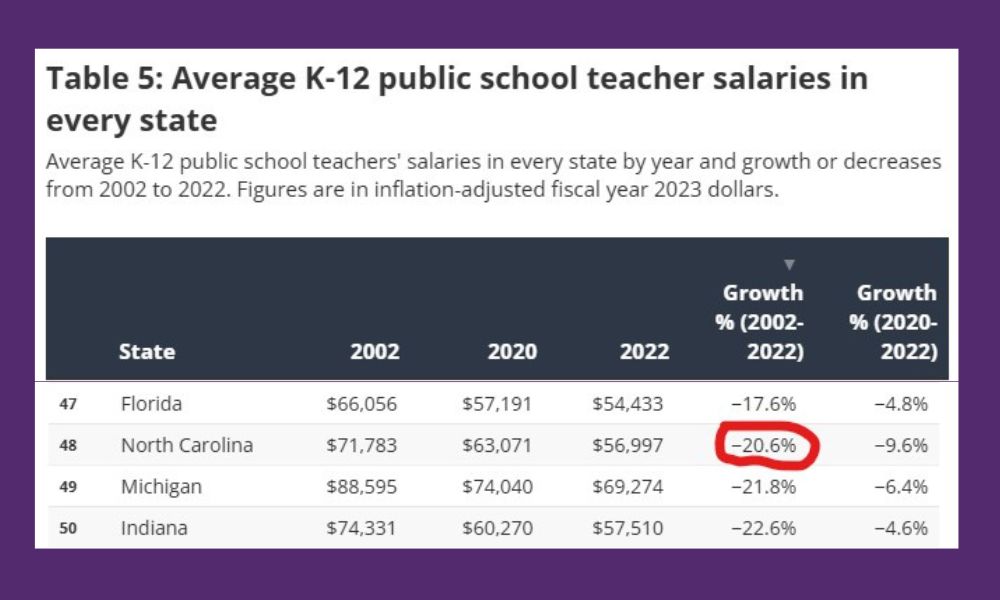
North Carolina ranked 48th in salary growth from 2002 through 2022, declining 20.6%
Public Schools First NC
A new report by the libertarian Reason Foundation used inflation-adjusted trends in public education from 2002 - 2023 to compare state spending.
RALEIGH, NC, UNITED STATES, December 17, 2025 /EINPresswire.com/ -- The Reason Foundation, a libertarian think tank, recently released a report focused on public school spending trends. Reason Foundation’s K-12 Education Spending Spotlight identifies North Carolina as one of the states with lowest-spending on education as compared to others.Reason Foundation researchers used data from the US Census Bureau and the National Center for Education Statistics for years 2002 through 2023 to show pre- and post-pandemic trends and identify key areas of interest for lawmakers and policymakers.
To compare apples to apples, the researchers used inflation-adjusted (to 2023) spending and salary values. For example, to calculate salary trends, they adjusted the 2002 teacher salaries by the amount of inflation from 2002 to 2023 to determine what the 2002 salary would be if it had simply kept up with inflation (i.e., had the same spending power).
Researchers found that nationwide, average teacher salaries declined 6.1% between 2002 and 2022. However, 5.6% of the drop came after 2020. Prior to the pandemic, average national salaries were mostly flat, growing by -0.6%.
North Carolina’s teacher salaries showed a stronger downward trend than nearly every state. Between 2002 and 2022, average salaries fell by 20.6% (i.e., grew -20.6%). Salaries fell 9.6% after the pandemic on top of the 11% drop before the pandemic.
In 2002, teachers in North Carolina made the equivalent of $71,783 (in 2023 dollars). In 2022, they made $56,997. That’s essentially a $14,786 salary cut.
North Carolina ranks 48th out of 50 states in the percent growth in teacher salaries since 2002. Only Michigan and Indiana’s teacher salaries grew less—by -21.8% and -22.6% respectively. But because salaries in both states started higher, their teachers ended up with higher average salaries in 2022 than North Carolina’s teachers.
Researchers also found that every state had increased spending on public education, with 2002 through 2023 increases ranging from 78.6% in California to 7.1% in Indiana. North Carolina’s education spending increase was the third lowest at 8.5%.
Public school enrollment grew in 29 states (including North Carolina) from 2002 to 2023, but fell in 39 states after the pandemic. North Carolina’s public school enrollment followed this pattern. Before the pandemic, from 2002 to 2020, North Carolina’s public school enrollment grew more than 18% and after the pandemic (from 2020 to 2023) dropped 1.2%, leaving the total growth at 17.2% from 2002 - 2023.
North Carolina’s public education spending grew by 8.5% from 2002 to 2023 while student enrollment grew by 17.2% during the same years.
Researchers also found that nationwide, public school funding is increasingly spent on employee benefits—including teacher pensions and health insurance—and less on employee salaries. They found that for every new $1.00 that public schools spent on employee salaries between 2002 and 2023, benefit expenditures rose by $3.27. The main driver of the rising benefit spending was pension debt. For years, states have failed to set aside enough money to cover future pension costs, so now there isn’t enough money in pension funds to pay benefits owed to employees who are retiring. States are cutting into current funds to cover pension costs.
Reason Foundation’s spotlight report provides an important perspective by using inflation-adjusted dollars to evaluate trends. By doing so, the report reveals trends that policymakers and lawmakers can evaluate when making future public school funding decisions.
Heather Koons
Public Schools First NC
info@publicschoolsfirstnc.org
Visit us on social media:
LinkedIn
Bluesky
Instagram
Facebook
YouTube
TikTok
Legal Disclaimer:
EIN Presswire provides this news content "as is" without warranty of any kind. We do not accept any responsibility or liability for the accuracy, content, images, videos, licenses, completeness, legality, or reliability of the information contained in this article. If you have any complaints or copyright issues related to this article, kindly contact the author above.
